
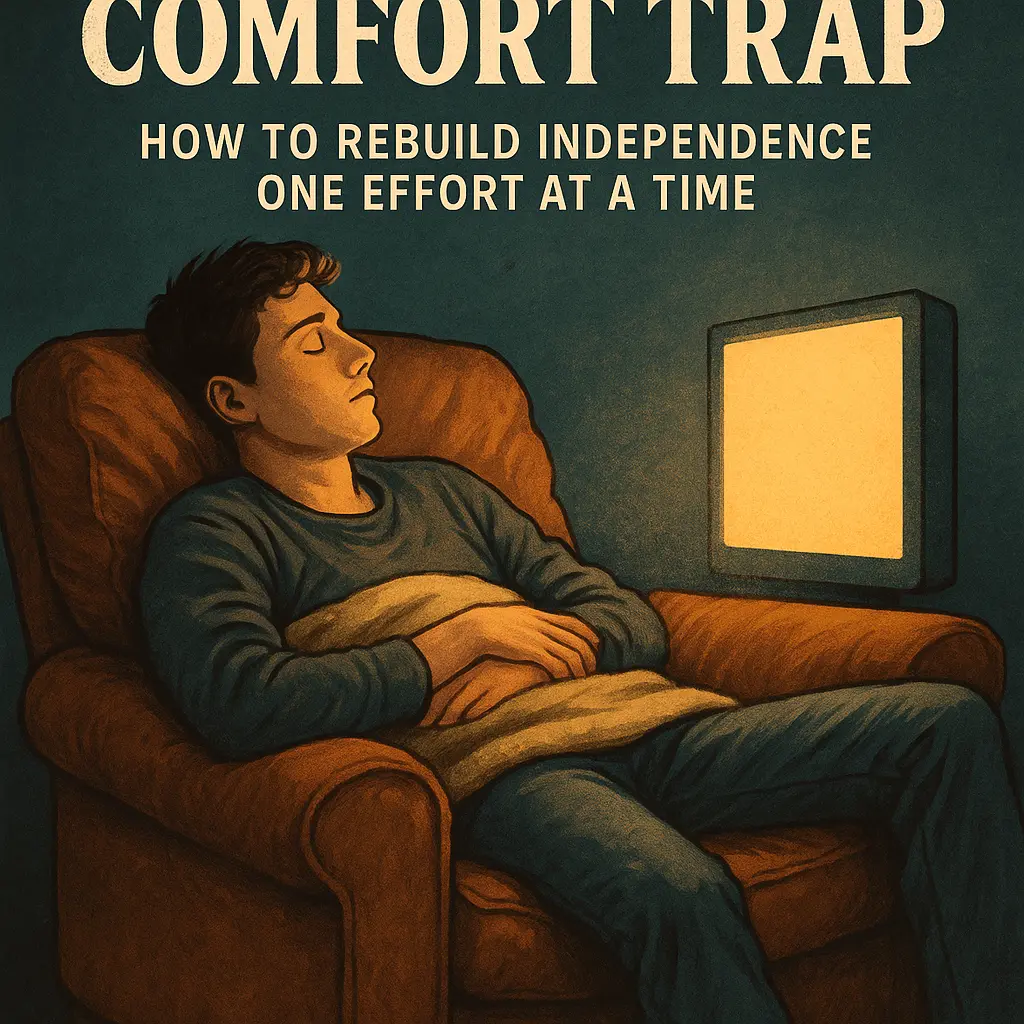
“Comfort is the quietest cage ever built. The bars are soft, the door is open, and most people never think to leave. That is the comfort trap.”
TL;DR
- Comfort hides dependency behind convenience.
- The comfort trap trades freedom for ease, one habit at a time.
- Discomfort builds skill and confidence. Avoiding it builds weakness.
- Every act of effort reclaims a piece of independence.
- Freedom starts when you stop outsourcing your own capability.
How the Comfort Trap Works
“The comfort trap never takes your freedom. It just teaches you not to use it.”
Comfort feels harmless at first. It rewards compliance with calm and disguises dependency as progress. The comfort trap does not force you to surrender. It convinces you to stop trying. Each time life gets easier, you lose another reason to stay sharp. Every shortcut, every app, and every automated task promises relief. What it really does is train you to sit still.
When effort disappears, attention disappears with it. The mind softens, the body follows, and soon you depend on systems to think, cook, move, and even decide. That is how independence fades. It happens quietly, hidden beneath ease that feels earned.
The Illusion of Progress
“Ease does not make you advanced. It makes you absent.”
Modern life sells convenience as evolution. It says progress means less work, fewer steps, and no struggle. The comfort trap builds on that lie. It tells you that difficulty is failure and friction is unnecessary. But friction builds skill. Effort keeps awareness alive.
Once everything becomes instant, you forget the patience that builds character. When you never have to wait, you stop learning how to prepare. When you never face resistance, you stop learning how to adapt. Ease feels like progress until something breaks and you realize you no longer know how to fix it.
The comfort trap does not punish mistakes. It removes the opportunity to make them. Without failure, you cannot grow. Without effort, you forget what success feels like.
Where the Comfort Trap Hides
“If it saves you thinking every time, it is training you to stop thinking at all.”
- Auto everything: Auto pay, auto renewals, and auto refills are convenient until you stop checking the details and lose track of your own decisions.
- Navigation on short routes: GPS for every trip dulls awareness. Try driving once without it and build a mental map again.
- Endless delivery: Groceries and meals arrive at your door. Time saved, skill lost. Plan one meal a week from scratch to keep your edge.
- Predictive content: Feeds that “know you” are designed to keep you scrolling, not thinking. Choose your sources intentionally.
- Smart defaults: Preset thermostats, schedules, and answers. Convenience is fine. Blind acceptance is not.
None of these are wrong by themselves. The danger is in the drift. Small handoffs accumulate until the day you realize you can no longer function without them.
Why Discomfort Builds Strength
“Discomfort is not pain. It is proof that you are paying attention again.”
Discomfort is not suffering. It is the process of rebuilding what automation erased. Every uncomfortable task you take on, from learning a skill to fixing something by hand, strengthens the part of you that comfort dulled. The more capable you become, the less dependent you are.
Start small. Carry the groceries without the cart. Turn off the GPS and find your way. Repair something instead of replacing it. Each act of effort wakes up the part of your mind that remembers how to solve problems. That is how independence grows. Not in ease, but in motion.
Training Effort Back Into Daily Life
“The comfort trap loses power the moment you choose effort on purpose.”
Breaking the comfort trap is not about rejecting technology or chasing hardship. It is about balance and choice. Effort should be a daily exercise. Challenge yourself to do one thing each day that requires attention and patience. Write by hand. Learn a manual skill. Read a full chapter without checking your phone. These simple acts train your mind to stay present.
Repetition turns friction into focus. When effort becomes normal again, comfort stops being a trap and becomes a tool. You decide when to use it instead of letting it use you.
A Seven-Day Comfort Trap Reset
“Short wins stack. Stacked wins change you.”
- Day 1: Cook one full meal from raw ingredients. Plan, shop, prepare, and clean. No apps, no shortcuts.
- Day 2: Drive to a familiar place with the GPS off. Notice landmarks and rebuild your internal compass.
- Day 3: Repair one small item. A button, a hinge, or a squeak. Use your hands before your wallet.
- Day 4: Spend one hour without screens. Read, write, or think. Let your mind handle silence.
- Day 5: Pay one bill manually. Review the numbers and reconnect with your financial awareness.
- Day 6: Do something physical before opening your phone. Walk, lift, stretch, or work outside.
- Day 7: Plan next week on paper. Pick three tasks that require effort. Put them on the calendar and complete them.
These steps are simple on purpose. The goal is not intensity but reactivation. Once the reflex to engage returns, bigger challenges become possible.
Using Effort Where It Counts
“Capability is confidence you can verify.”
Effort without direction feels like grind. Effort with direction feels like growth. Aim your renewed discipline at projects that produce proof. Build a garden bed. Learn to use a new tool. Finish a long read. Teach a skill to someone else. Proof beats motivation because proof settles the argument inside your head.
Keep a simple log. One line per day. Record what you faced, what you finished, and what you learned. That record becomes a barrier between you and old habits. The comfort trap struggles to survive in people who keep proof of progress.
When Comfort Helps and When It Hurts
“Comfort that follows effort restores you. Comfort that replaces effort erodes you.”
Use comfort as recovery, not replacement. Sleep in a quiet room. Eat a good meal after real work. Sit down when the job is done. These comforts strengthen you because they follow action. Avoid comfort that arrives first, the kind that prevents you from starting. That version weakens your edge one small surrender at a time.
Freedom Through Effort
“Freedom starts where comfort ends.”
Freedom is not the absence of work. It is the mastery of it. Each challenge you face willingly builds discipline. Each obstacle you confront consciously builds awareness. These are not punishments. They are proof that you are alive and capable.
The comfort trap thrives on your desire for peace. It tells you that calm is safety and struggle is waste. But peace without effort is sedation. Real calm comes from competence, the kind that only effort can build.
Step outside the comfort trap. Choose effort again. Each task you take on for yourself is a small rebellion against dependency. That is how independence is rebuilt, one effort at a time.
Freedom starts in the mind. Light the Fuse.
FAQ
What is the comfort trap?
It is the slow surrender of independence to convenience. You trade capability for comfort until you forget how to function without it.
Is comfort always bad?
No. Earned comfort restores energy. Unexamined comfort removes awareness.
How do I break free from the comfort trap?
Do one difficult thing every day. Each small act of effort builds confidence and rewires dependency.
How does effort create freedom?
Effort restores self-trust. The more capable you become, the fewer systems can control you.
What is the first step?
Pay attention to what feels too easy. That is where the trap begins.
How do I keep momentum once I start?
Track your proof, build non-negotiable routines, and focus effort on projects that matter to you.
Stay Sharp. Stay Free
No noise. No fluff. Just unfiltered insight on independence, mindset, and critical thought direct from Jason Schaller.
You’ll get:
- Actionable ideas to reclaim your independence
- Deep dives into comfort, control, and how to resist both
- Stories that challenge the systems training you to stop thinking
- Real frameworks for critical thought and self-reliance
Support & Resources
If you value what I write here, share it. Every repost, mention, and conversation helps spread the spark of independent thought.
Credits and Socials
Connect with Me:
Follow for new articles, behind-the-scenes content, and thought experiments that challenge the system:
- X (Twitter) – x.com/jasonsfuse
- LinkedIn – linkedin.com/in/jasonschaller
- Bluesky – jasonsfuse.bsky.social
- Threads – threads.com/jasonsfuse
- TikTok – tiktok.com/@jasonsfuse
- Instagram – instagram.com/jasonsfuse
- YouTube – YouTube.com/@jasonsfuse
- The Square Reviews – thesquarereviews.com/author/jason-schaller/
- Website – jasonsfuse.com
Credits:
Original Content by Jason’s Fuse / My Rogue Solutions LLC
Credit: Jason Schaller
Email: jschaller@jasonsfuse.com
About the Author:
Jason Schaller is the creator of Jason’s Fuse — unfiltered thinking on independence, critical thought, and the courage to question everything. He is also the founder of The Rogue Banshee, a former professional gunsmith of 10 years, and a cybersecurity professional with nearly 30 years of experience. He holds some of the top Cybersecurity credentials like the CISSP, CISA and CRISC.
Disclaimers
Content Use & Responsibility
Jason’s Fuse publishes opinion and commentary designed to encourage independent thought. The ideas shared here are for informational and educational purposes only. Readers are encouraged to verify sources, form their own opinions, and apply judgment responsibly.
Affiliate Disclaimer
Some links may be affiliate-based. They cost you nothing but help support the mission of building true independence and critical thought.
Ethics Notice
Opinions expressed are Jason’s own and do not represent any employer or partner organization. All statements are made in good faith based on verified information at the time of writing.