The Comfort Trap: How to Rebuild Independence One Effort at a Time

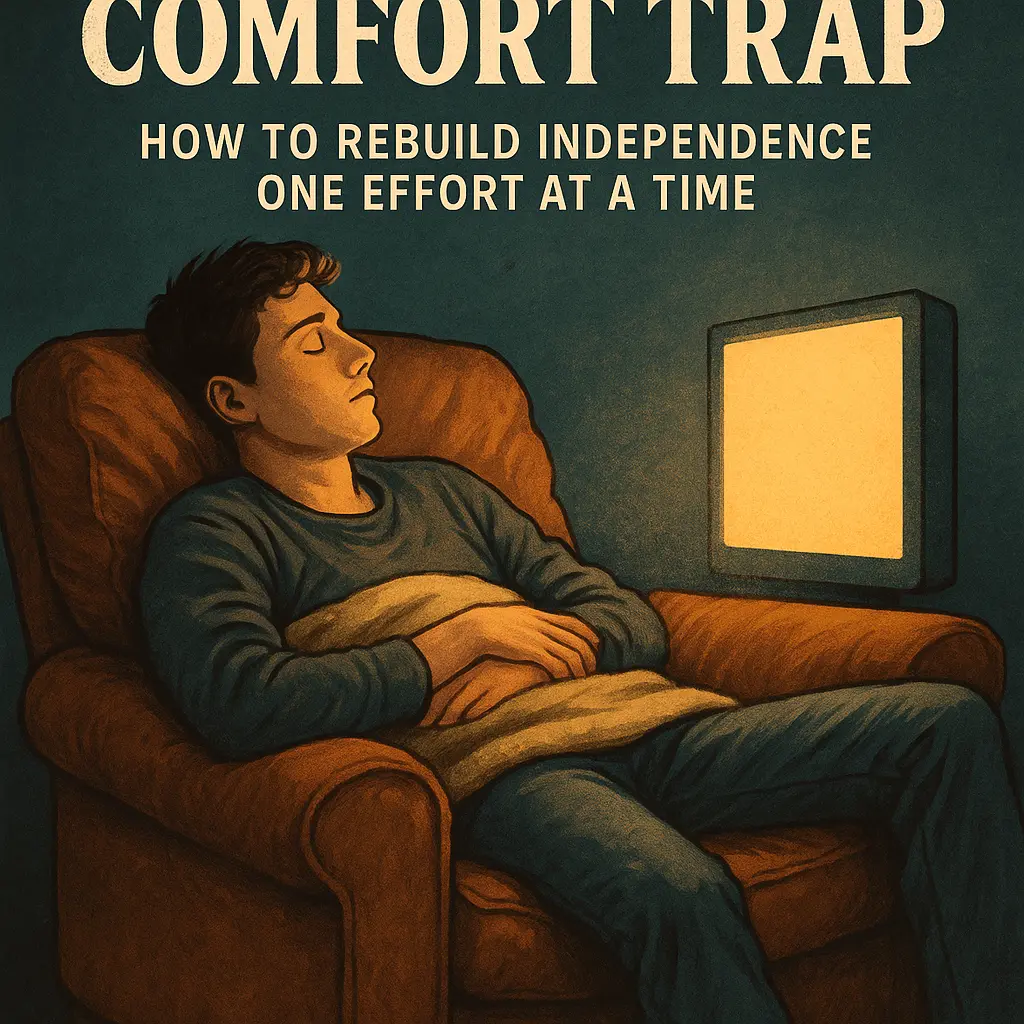
A digital illustration of a person sinking into a glowing couch surrounded by screens, with faint shadowy chains in the background symbolizing control through comfort.

“Comfort is the quietest cage ever built. The bars are soft, the door is open, and most people never think to leave. That is the comfort trap.”

TL;DR

  • Comfort hides dependency behind convenience.
  • The comfort trap trades freedom for ease, one habit at a time.
  • Discomfort builds skill and confidence. Avoiding it builds weakness.
  • Every act of effort reclaims a piece of independence.
  • Freedom starts when you stop outsourcing your own capability.

How the Comfort Trap Works

“The comfort trap never takes your freedom. It just teaches you not to use it.”

Comfort feels harmless at first. It rewards compliance with calm and disguises dependency as progress. The comfort trap does not force you to surrender. It convinces you to stop trying. Each time life gets easier, you lose another reason to stay sharp. Every shortcut, every app, and every automated task promises relief. What it really does is train you to sit still.

When effort disappears, attention disappears with it. The mind softens, the body follows, and soon you depend on systems to think, cook, move, and even decide. That is how independence fades. It happens quietly, hidden beneath ease that feels earned.

The Illusion of Progress

“Ease does not make you advanced. It makes you absent.”

Modern life sells convenience as evolution. It says progress means less work, fewer steps, and no struggle. The comfort trap builds on that lie. It tells you that difficulty is failure and friction is unnecessary. But friction builds skill. Effort keeps awareness alive.

Once everything becomes instant, you forget the patience that builds character. When you never have to wait, you stop learning how to prepare. When you never face resistance, you stop learning how to adapt. Ease feels like progress until something breaks and you realize you no longer know how to fix it.

The comfort trap does not punish mistakes. It removes the opportunity to make them. Without failure, you cannot grow. Without effort, you forget what success feels like.

Where the Comfort Trap Hides

“If it saves you thinking every time, it is training you to stop thinking at all.”

  • Auto everything: Auto pay, auto renewals, and auto refills are convenient until you stop checking the details and lose track of your own decisions.
  • Navigation on short routes: GPS for every trip dulls awareness. Try driving once without it and build a mental map again.
  • Endless delivery: Groceries and meals arrive at your door. Time saved, skill lost. Plan one meal a week from scratch to keep your edge.
  • Predictive content: Feeds that “know you” are designed to keep you scrolling, not thinking. Choose your sources intentionally.
  • Smart defaults: Preset thermostats, schedules, and answers. Convenience is fine. Blind acceptance is not.

None of these are wrong by themselves. The danger is in the drift. Small handoffs accumulate until the day you realize you can no longer function without them.

Why Discomfort Builds Strength

“Discomfort is not pain. It is proof that you are paying attention again.”

Discomfort is not suffering. It is the process of rebuilding what automation erased. Every uncomfortable task you take on, from learning a skill to fixing something by hand, strengthens the part of you that comfort dulled. The more capable you become, the less dependent you are.

Start small. Carry the groceries without the cart. Turn off the GPS and find your way. Repair something instead of replacing it. Each act of effort wakes up the part of your mind that remembers how to solve problems. That is how independence grows. Not in ease, but in motion.

Training Effort Back Into Daily Life

“The comfort trap loses power the moment you choose effort on purpose.”

Breaking the comfort trap is not about rejecting technology or chasing hardship. It is about balance and choice. Effort should be a daily exercise. Challenge yourself to do one thing each day that requires attention and patience. Write by hand. Learn a manual skill. Read a full chapter without checking your phone. These simple acts train your mind to stay present.

Repetition turns friction into focus. When effort becomes normal again, comfort stops being a trap and becomes a tool. You decide when to use it instead of letting it use you.

A Seven-Day Comfort Trap Reset

“Short wins stack. Stacked wins change you.”

  1. Day 1: Cook one full meal from raw ingredients. Plan, shop, prepare, and clean. No apps, no shortcuts.
  2. Day 2: Drive to a familiar place with the GPS off. Notice landmarks and rebuild your internal compass.
  3. Day 3: Repair one small item. A button, a hinge, or a squeak. Use your hands before your wallet.
  4. Day 4: Spend one hour without screens. Read, write, or think. Let your mind handle silence.
  5. Day 5: Pay one bill manually. Review the numbers and reconnect with your financial awareness.
  6. Day 6: Do something physical before opening your phone. Walk, lift, stretch, or work outside.
  7. Day 7: Plan next week on paper. Pick three tasks that require effort. Put them on the calendar and complete them.

These steps are simple on purpose. The goal is not intensity but reactivation. Once the reflex to engage returns, bigger challenges become possible.

Using Effort Where It Counts

“Capability is confidence you can verify.”

Effort without direction feels like grind. Effort with direction feels like growth. Aim your renewed discipline at projects that produce proof. Build a garden bed. Learn to use a new tool. Finish a long read. Teach a skill to someone else. Proof beats motivation because proof settles the argument inside your head.

Keep a simple log. One line per day. Record what you faced, what you finished, and what you learned. That record becomes a barrier between you and old habits. The comfort trap struggles to survive in people who keep proof of progress.

When Comfort Helps and When It Hurts

“Comfort that follows effort restores you. Comfort that replaces effort erodes you.”

Use comfort as recovery, not replacement. Sleep in a quiet room. Eat a good meal after real work. Sit down when the job is done. These comforts strengthen you because they follow action. Avoid comfort that arrives first, the kind that prevents you from starting. That version weakens your edge one small surrender at a time.

Freedom Through Effort

“Freedom starts where comfort ends.”

Freedom is not the absence of work. It is the mastery of it. Each challenge you face willingly builds discipline. Each obstacle you confront consciously builds awareness. These are not punishments. They are proof that you are alive and capable.

The comfort trap thrives on your desire for peace. It tells you that calm is safety and struggle is waste. But peace without effort is sedation. Real calm comes from competence, the kind that only effort can build.

Step outside the comfort trap. Choose effort again. Each task you take on for yourself is a small rebellion against dependency. That is how independence is rebuilt, one effort at a time.

Freedom starts in the mind. Light the Fuse.

FAQ

What is the comfort trap?
It is the slow surrender of independence to convenience. You trade capability for comfort until you forget how to function without it.

Is comfort always bad?
No. Earned comfort restores energy. Unexamined comfort removes awareness.

How do I break free from the comfort trap?
Do one difficult thing every day. Each small act of effort builds confidence and rewires dependency.

How does effort create freedom?
Effort restores self-trust. The more capable you become, the fewer systems can control you.

What is the first step?
Pay attention to what feels too easy. That is where the trap begins.

How do I keep momentum once I start?
Track your proof, build non-negotiable routines, and focus effort on projects that matter to you.

Stay Sharp. Stay Free

No noise. No fluff. Just unfiltered insight on independence, mindset, and critical thought direct from Jason Schaller.

You’ll get:

  • Actionable ideas to reclaim your independence
  • Deep dives into comfort, control, and how to resist both
  • Stories that challenge the systems training you to stop thinking
  • Real frameworks for critical thought and self-reliance

Support & Resources

If you value what I write here, share it. Every repost, mention, and conversation helps spread the spark of independent thought.

Credits and Socials

Connect with Me:
Follow for new articles, behind-the-scenes content, and thought experiments that challenge the system:

Credits:
Original Content by Jason’s Fuse / My Rogue Solutions LLC
Credit: Jason Schaller
Email: jschaller@jasonsfuse.com

About the Author:
Jason Schaller is the creator of Jason’s Fuse — unfiltered thinking on independence, critical thought, and the courage to question everything. He is also the founder of The Rogue Banshee, a former professional gunsmith of 10 years, and a cybersecurity professional with nearly 30 years of experience. He holds some of the top Cybersecurity credentials like the CISSP, CISA and CRISC.

Disclaimers

Content Use & Responsibility
Jason’s Fuse publishes opinion and commentary designed to encourage independent thought. The ideas shared here are for informational and educational purposes only. Readers are encouraged to verify sources, form their own opinions, and apply judgment responsibly.

Affiliate Disclaimer
Some links may be affiliate-based. They cost you nothing but help support the mission of building true independence and critical thought.

Ethics Notice
Opinions expressed are Jason’s own and do not represent any employer or partner organization. All statements are made in good faith based on verified information at the time of writing.
The Compliance Machine: How to Rebuild Freedom One Choice at a Time

A digital illustration of a person surrounded by glowing screens and soft mechanical tendrils, symbolizing how comfort programs obedience in the modern world.

“The compliance machine does not shout. It comforts you until you accept its limits as your own.”

TL;DR

  • Comfort is the new control because it feels like freedom.
  • Every shortcut you take makes you easier to guide.
  • Ease trains obedience one habit at a time.
  • Friction builds skill, awareness, and independence.
  • Effort is how you take back control from the machine.

Comfort’s Quiet Conversion

“The compliance machine begins where attention ends.”

Comfort used to be the reward after the work. Now it’s the trap that keeps you from noticing who’s holding the door open. You set auto pay, your car steers for you, your phone fills in the blanks. Every feature saves a few seconds. Thing is, each one steals a reason to stay sharp.

You still choose, but you’re choosing from a list someone else built. That’s how comfort turns into quiet control. The machine doesn’t need to chain you. It just keeps you entertained long enough to stop caring who’s writing the rules. Earlier this week in The Obedience Trap, we talked about how comfort shapes obedience. Now we’re looking at how that comfort becomes policy and why that should worry you.

The Design of Easy Obedience

“Obedience today is designed, not demanded.”

The Illusion of Choice

The compliance machine doesn’t bark orders. It studies behavior instead. Every click, search, and swipe tells it what you want next. You think you’re asking for help, but you’re training it. It learns what makes you pause and what makes you scroll. The smoother it feels, the more you let it decide for you. In time, you’re not choosing. You’re reacting on cue.

When life gets too easy, you stop noticing what it costs. You skip the mental reps that keep instincts sharp. And once that happens, the pattern is locked in. You’re predictable. The system calls that “personalized.” It’s not. It’s domesticated.

Comfort as Reinforcement

Small frictions used to make you better. You learned patience through trial and error. You built memory by doing. Now anything that slows you down gets “optimized.” You forget how to solve problems because the screen finishes your thoughts. It feels efficient, but it’s really training. The machine gives comfort, and you return control. Sounds fair, right?

It’s not theft. It’s conditioning. You teach the system what to expect, and it rewards you with convenience. That’s why awareness is the first thing to go. The less you notice, the more it wins.

The Comfort Economy

“When comfort becomes currency, awareness becomes debt.”

The Marketplace of Ease

Convenience now sells faster than quality. Companies don’t need your loyalty. They only need your habits. Every “save time” feature becomes a small subscription to someone else’s control. They automate your attention until you stop asking questions. It’s not conspiracy. It’s capitalism with an algorithm. Still, it feels harmless enough to keep you hooked.

The less effort you make, the more predictable you become. Predictable people are easy to monetize. The machine rewards the behavior it can count on. You feel cared for, but what you really are is managed.

When Convenience Shapes Belief

“Comfort doesn’t argue. It just repeats until you stop questioning.”

The machine doesn’t need to censor you. It just fills your feed with what keeps you calm. The content that’s easy to digest gets boosted. The posts that make you think get buried. You think you’re informed. You’re just being handled. Thought takes effort, and effort kills engagement. That’s why the shallow stuff always wins. After a while, it becomes habit.

Eventually, you defend the noise because it’s familiar. You mistake comfort for truth. That’s how belief becomes branding. You’re not persuaded. You’re programmed. And once that happens, the cycle runs itself.

Inside the Loop

“The compliance machine doesn’t silence you. It distracts you until silence feels awkward.”

The Reward System of Distraction

I see this from both sides. As a creator, my reach grows when you keep scrolling. If you stop to think, I get punished. So what happens? You cut slow moments, trim nuance, and feed the loop. The system rewards noise, not depth. You either play the game or vanish from it. That’s the choice, and it’s not really a choice at all.

That logic bleeds into everything. News runs on outrage because it sells. Schools teach compliance because it grades easier. Work worships efficiency because judgment takes time. Attention became the currency, and the machine prints it. Whoever controls the feed controls the narrative. You can feel it every time you open your phone.

Beyond Screens

The same pattern runs offline. Meetings become performances. Families share rooms but not words. Communities trade truth for peace and call it unity. Comfort smooths everything out but leaves it hollow. The machine doesn’t have to break you. It just needs you tired enough to scroll instead of think. And for most people, that’s enough.

From Ease to Dependency

“The skills you stop practicing become services someone sells you later.”

Dependency as Design

Dependency feels like luxury until the power goes out. You stop cooking because food shows up at your door. You stop remembering because your phone never forgets. You stop fixing because next-day delivery exists. Feels smart, right? Until the system hiccups and you can’t function without it. That’s when you realize how much you’ve outsourced your own life.

That’s not by accident. The setup rewards helplessness because helpless people buy solutions. The system doesn’t need to say no. It just teaches you to ask permission. It’s polite, efficient, and absolute.

Why Friction Protects Memory

Friction keeps your brain from running on autopilot. Write something by hand. Fix what’s broken. Plan a route without the map. You’ll feel the gears turn again. You’ll catch details you used to miss. The awareness you think you lost is still there. You just stopped feeding it. And when you bring it back, you remember how to live without permission.

The Creator’s Compromise

“If the platform pays you for time, it owns your message.”

What Algorithms Teach Creators

Every platform has the same rule. Keep people here. The algorithm rewards watch time, not thought. So creators trim edges and simplify. The system doesn’t ask for lies. It just makes honesty unprofitable. You can say what you want, just not long enough to make anyone think. That’s how compliance pays its bills.

I fight that, but the pressure is constant. If I make something that slows you down, the system hides it. If I make something that keeps you swiping, it promotes it. That’s the trade. The machine doesn’t censor. It trains obedience with reach and dopamine. The reward is exposure, and the cost is integrity.

Rebuilding Through Effort

“Effort is the quiet form of rebellion.”

Small Acts That Restore Attention

The fix isn’t dramatic. It’s small and deliberate. Cook one meal from memory. Read something long without checking your phone. Repair a tool instead of tossing it. Every time you do, your brain wakes up a little more. The more effort you make, the less predictable you become. Freedom lives in that friction. And once you feel it, you’ll never unsee it.

You don’t need a plan. You need practice. Rebuild the muscle one task at a time. Soon, you’ll think before the app can finish your sentence. That’s awareness coming back online, and that’s what breaks the loop.

Earned Comfort as Independence

Comfort isn’t bad. Unearned comfort is. The kind that dulls instead of recharges. Earned comfort builds strength. Lazy comfort steals it. The goal isn’t suffering. It’s ownership. When you build or fix something yourself, you own it twice. Once for having it. Again for understanding it.

Do one hard thing today. Then another tomorrow. Keep going until hard feels normal. That’s when the machine loses control. It can still tempt you with ease, but it can’t buy your obedience anymore. That’s what freedom feels like, and it starts in small decisions you take back for yourself.

Freedom starts in the mind. Light the Fuse.

FAQ

“The questions you stop asking are the ones that define your obedience.”

What is the compliance machine?
It’s the system that trades convenience for awareness and calls it progress.

How does comfort control people?
By making life so easy you stop questioning who’s running it.

Is all comfort bad?
No. Earned comfort builds strength. The kind that replaces work erases it.

How can I fight it?
Do something difficult on purpose. Fix something. Learn something. Think for yourself. Every bit of friction keeps you free.

Why does it matter?
Because skills you forget become dependencies you pay for later. That’s how comfort wins. Awareness wins it back.

Stay Sharp. Stay Free

No noise. No fluff. Just unfiltered insight on independence, mindset, and critical thought direct from Jason Schaller.

You’ll get:

  • Actionable ideas to reclaim your independence
  • Deep dives into comfort, control, and how to resist both
  • Stories that challenge the systems training you to stop thinking
  • Real frameworks for critical thought and self-reliance

Support & Resources

If you value what I write here, share it. Every repost, mention, and conversation helps spread the spark of independent thought.

Credits and Socials

Connect with Me:
Follow for new articles, behind-the-scenes content, and thought experiments that challenge the system:

Credits:
Original Content by Jason’s Fuse / My Rogue Solutions LLC
Credit: Jason Schaller
Email: jschaller@jasonsfuse.com

About the Author:
Jason Schaller is the creator of Jason’s Fuse — unfiltered thinking on independence, critical thought, and the courage to question everything. He is also the founder of The Rogue Banshee, a former professional gunsmith of 10 years, and a cybersecurity professional with nearly 30 years of experience. He holds some of the top Cybersecurity credentials like the CISSP, CISA and CRISC.

Disclaimers

Content Use & Responsibility
Jason’s Fuse publishes opinion and commentary designed to encourage independent thought. The ideas shared here are for informational and educational purposes only. Readers are encouraged to verify sources, form their own opinions, and apply judgment responsibly.

Affiliate Disclaimer
Some links may be affiliate-based. They cost you nothing but help support the mission of building true independence and critical thought.

Ethics Notice
Opinions expressed are Jason’s own and do not represent any employer or partner organization. All statements are made in good faith based on verified information at the time of writing.

The Obedience Trap: How Algorithms Silently Rewire Your Mind

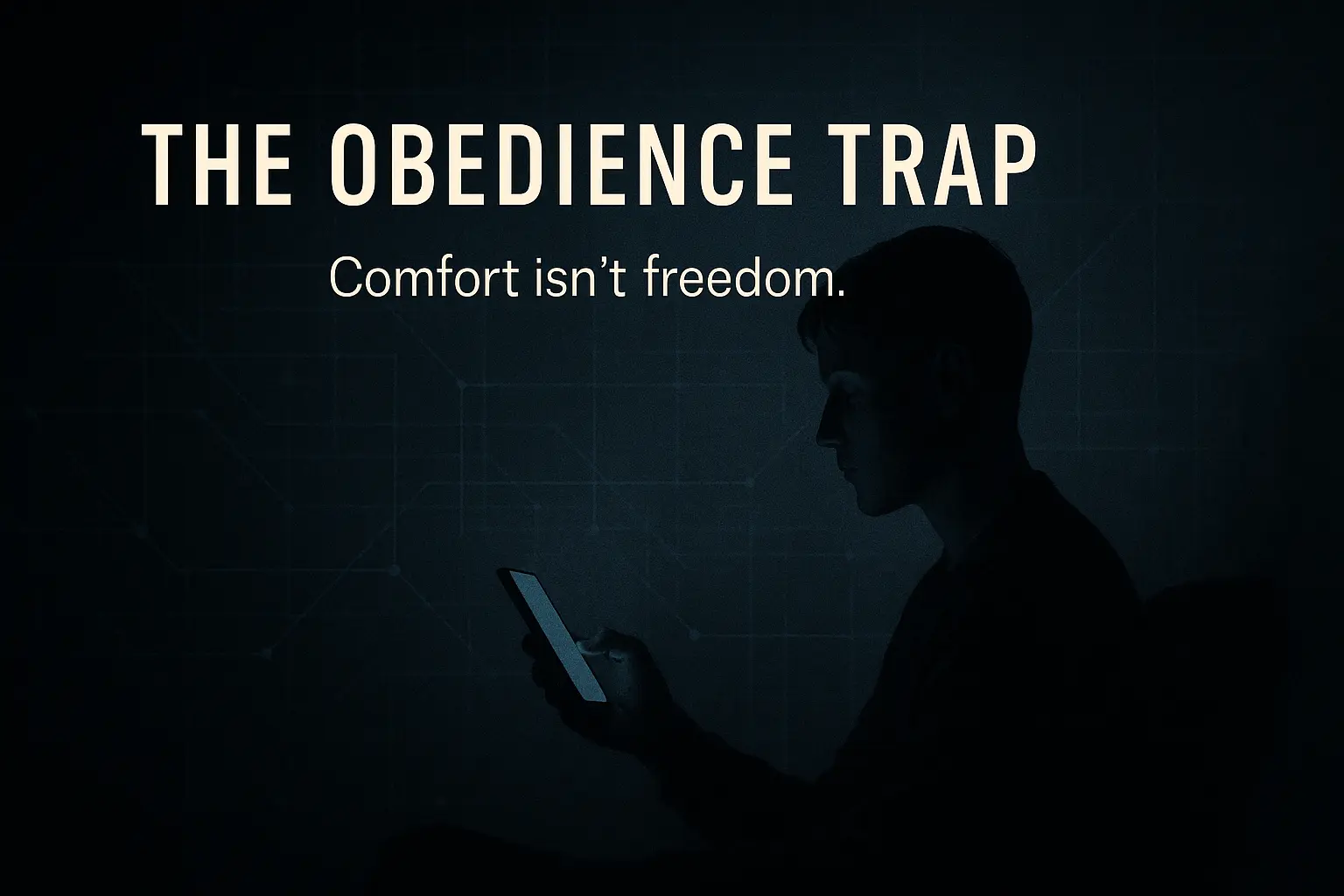
Person bathed in cold phone light surrounded by faint algorithm lines, representing the obedience trap and algorithmic control through comfort.

“The obedience trap doesn’t need chains. It uses algorithms that learn what you’ll think next.”

TL;DR

  • The obedience trap hides inside predictive algorithms that reward comfort and compliance.
  • The algorithm of obedience replaces awareness with automation so you stop choosing on purpose.
  • Convenience becomes the leash that guides attention and behavior.
  • Awareness and small frictions break the loop and rebuild independence.
  • Freedom starts when you choose effort over ease and inputs over autoplay.
It starts simple, and that is why it works. A nudge. A ping. A recommendation that lands at the exact moment you are bored. The obedience trap never announces itself. Instead, it arrives as help. You save a few seconds. Then you save a few more. Soon the system carries your attention for you, and because it feels smooth, you stop noticing who is steering.

Control used to look like authority. Now it looks like options. You are not told what to do, because that would wake you up. You are guided. You are offered what feels right because the system already knows what has worked on you before. So you keep accepting suggestions, and the loop learns faster than you question it.

That is the point. The less you feel the effort of choosing, the more predictable you become. Predictability is the fuel that powers the obedience trap, and the algorithm of obedience is very good at gathering it.

Predictive Algorithms and the Modern Obedience Trap

“When prediction replaces persuasion, freedom becomes a variable in someone else’s equation.”

The old systems demanded loyalty with rules. The new ones design loyalty with data. Predictive algorithms do not wait for your decisions. Instead, they study your pauses, your replays, and your returns. Then they serve the next thing you are most likely to accept. Because of that, you rarely feel pushed. You simply feel catered to.

Platforms do not need to know why you react. They only need to know that you will. Anger spikes attention. Comfort extends it. Both keep you engaged, and engagement is the currency that pays for more of the same. So the loop tightens. You scroll. You react. You get rewarded with familiarity, and that familiarity feels like safety.

After a while you stop asking basic questions. Who chose this for me. What is missing from this feed. Why do I keep seeing the same kinds of ideas. The obedience trap thrives when those questions go quiet. It does not need force. It needs repetition.

You think you are exploring. In reality, you are being steered toward what the model predicts. That is not a conspiracy. It is product design.

Data, Comfort, and Digital Control Systems

“Convenience builds the cage. Prediction locks it.”

Every connected tool learns you. Phones, watches, televisions, speakers, cameras, and thermostats record patterns that used to live only in your head. As a result, the system understands your timing better than you do. It knows when you sit, when you snack, and when you swipe without thinking. That knowledge feeds digital control systems that promise efficiency while quietly standardizing your habits.

There is always a trade. Awareness for automation. It feels efficient at first, and that is why people accept it. Later, the cost shows up as lost attention and a weaker ability to choose without prompts. Because the loop still delivers results, you rarely notice what you gave away to get them.

I see this from both sides because I create content. On The Rogue Banshee, best practice on every platform is the same. Keep viewers on the platform. Watch time and retention are the gods that get offerings. If I hold you longer, the algorithm promotes the video. If you leave early, the system buries it. That incentive shapes creators and viewers at the same time, so the machine trains all of us to serve its metrics.

The platform does not care if you learn anything useful. It cares that you stay. That is the algorithm of obedience at work. It rewards predictable behavior and quietly punishes anything that interrupts the loop.

Privacy used to be a legal problem. Today it is mostly a discipline problem. Once you stop caring who is watching, control stops asking permission. That shift is how the cage closes without noise.

The Algorithm of Obedience and the Comfort Trap

“Every machine designed to help you eventually learns how to guide you.”

Comfort changes how people think. First it removes friction, and then it removes the desire to notice. Because the task feels easy, awareness feels optional. That is the perfect environment for the obedience trap. The system does not need to limit your choices if it can predict them. It does not need to pressure you if comfort already ensures cooperation.

We talked about this pattern in Comfort’s Quiet Lie. Ease builds dependency, and dependency lowers vigilance. Once the platform automates your preferences, it also automates your attention. The result is quiet control that looks like service.

It helps to name what you trade away. You save time, but you also lose practice in choosing. You gain speed, but you lose curiosity. You get convenience, but you give up the small frictions that keep the mind awake. Those frictions are not annoyances. They are signals. They tell you that you are present.

So the machine feels more helpful as you grow more passive. That is how conditioning hides in plain sight.

Inside the Obedience Trap: A Creator’s Reflection

“If the metric owns your choices, the metric owns your message.”

I will be blunt. The algorithm has tried to train me too. I have caught myself building edits that exist only to satisfy retention. I have watched a cut on the timeline and asked the wrong question. Will this hold viewers rather than will this teach the truth. The difference seems small, yet it changes the outcome.

There is nothing wrong with engaging work. There is a problem when engagement becomes the only purpose. Because of that tension, I put guardrails in place. If I make a short, I still keep the point honest. If I write a guide, I put the steps and the tools above the dopamine. Those lines cost reach sometimes, and that is fine. I would rather keep the message clean than win at a game that turns both creator and viewer into inventory.

I share this because it shows how the obedience trap works from the other side of the screen. The algorithm of obedience does not just train consumers. It also trains the people who build the content. If we are not careful, everyone ends up serving the same loop for different reasons.

How to Recognize the Obedience Trap in Daily Life

“If every choice feels easy, you are probably not the one choosing.”

Recognition is the first step, so start where you live. When a video autoplays, ask who started that choice. If a feed repeats the same kinds of ideas, ask what fell out of view. When a tool says it will handle it for you, ask what skill you no longer practice. These questions slow you down, and slowing down breaks the rhythm that control depends on.

Then look for patterns. Similar headlines that point to the same emotion. Reels that match your mood from yesterday. Product suggestions that appear right after a conversation. None of this is magic. It is correlation turned into prediction. As you notice the pattern, you also notice how comfortable that pattern feels. That comfort is the signal to pause.

Finally, check your language. If you catch yourself saying it is just easier, stop and test that belief. Sometimes easier is honest. Other times easier is how the obedience trap sells compliance.

Reclaiming Awareness from the Obedience Trap

“Freedom isn’t random. It is manual.”

Breaking the loop does not require a purge. You can simply start acting on purpose again. Small frictions work, and they work quickly. Turn off autoplay so a human makes the next choice. Disable most push notifications so you decide when to look. Use search instead of scroll so intention sets the path. Read something long when your brain wants short so focus gets a workout.

At first this feels awkward, and that feeling is useful. It means the habit is losing power. Stay with it for a week. You will notice silence you did not know you were missing. That silence is where attention lives, and attention is the first freedom you can take back.

It also helps to reclaim a domain of your life by hand. Cook one meal from memory. Plan a route without the map for a simple drive. Review your subscriptions and cancel anything that relies on your inattention. These choices seem small, yet they repair the muscle that control tries to weaken.

Momentum builds, and it builds faster than you think. After a few days you will feel the difference between rest and sedation. Rest follows effort and returns strength. Sedation follows exhaustion and steals it. Choose rest. Reject sedation. Your future self will thank you, and so will your attention span.

Awareness Is the Escape from Algorithmic Control

“The future does not belong to the obedient. It belongs to the awake.”

Freedom is not the absence of systems. It is the ability to see them clearly and still act on purpose. Once you understand how the algorithm shapes behavior, you stop being easy to shape. Because of that clarity, you will use the same tools differently. You will decide when, why, and how. The system can suggest, but it cannot command a mind that notices.

Awareness will not trend. It rarely goes viral. It does not fit into a hook. That is fine. Awareness does not exist to entertain. It exists to make you hard to program. The obedience trap loses power every time you pause, ask who benefits, and choose your own input.

You do not need to destroy technology. You only need to put it back in the place it belongs. A tool serves the person who uses it. A trap serves the system that built it. Keep your tools. Refuse the trap.

If comfort was the bait and prediction was the net, awareness is the cut that sets you free. Use it often. Share it with people who forgot what choosing feels like. Then practice again tomorrow, because the loop will always try to rebuild itself.

Freedom starts in the mind. Light the Fuse.

FAQ

What is the obedience trap?
It is the system of predictive algorithms that quietly rewire behavior by rewarding comfort and predictability.

What is the algorithm of obedience?
It is the engine behind the trap. The model studies attention, predicts reactions, and adjusts what you see to keep you engaged and compliant.

How does this become control?
Once your behavior is predictable, no one needs to force you. The system guides your choices while you believe you are choosing freely.

Can you break free from it?
Yes. Start with friction. Turn off autoplay, disable most notifications, and choose long form when you can. Those changes make the loop less accurate, and you regain awareness.

Why does this matter?
Because the obedience trap does not just shape habits. It shapes who you become, and your future depends on the choices you make with your own attention.

Your Attention Is the Battlefield: How to Reclaim Control in a Distracted World

A man sits calmly at a desk surrounded by glowing computer monitors filled with social media feeds, news, and notifications. He turns one screen off while warm orange light contrasts with cool blue monitor light, symbolizing reclaiming control of attention in a distracted world.

“Your attention is the real currency of control. Whoever owns it, owns you. Let’s reclaim control now!”

TL;DR

  • Your attention builds the system you serve.
  • Distraction is not entertainment. It is control with better graphics.
  • Awareness without discipline changes nothing.
  • Every focused minute is a small act of rebellion.
  • Reclaim control by reclaiming where you look.

Your Attention Is the Battlefield

All week, we focused on awareness and discipline. On Monday, you learned to think for yourself. On Wednesday, you practiced training calm when the world trains panic. Today is about turning those skills into action where the real fight happens. Your attention.

Every headline, feed, and alert fights for it. Every ad, influencer, and algorithm competes to hold it. Control does not need chains when it can keep your eyes busy. Once you lose control of your attention, everything that follows is easier to steer.

“Distraction is not harmless. It is the leash you volunteer to wear.”

What you focus on becomes what you build. Your time, your thoughts, and your future all follow your attention. If you want to reclaim control, start by reclaiming what you give it to.

The Moment I Noticed

It hit me one night in my office. I opened my laptop to finish a report and found myself scrolling a feed I did not even remember opening. Fifteen minutes gone. No decision. No purpose. Just reaction. That moment burned in my head because I realized I was being trained.

Distraction had become my default. Every alert promised something new, but nothing meaningful. It was comfort disguised as curiosity. I was feeding a machine that never gets full. I shut the screen and sat in the quiet, angry at myself but awake for the first time in a long time.

That was the day I decided to treat my attention the way I treat my security keys. Guarded, deliberate, and never shared without intent.

How Control Slips Away

Control rarely disappears in one moment. It fades through small choices that feel harmless. A scroll before bed. A quick check at lunch. A tab open while you work. Attention leaks through the cracks until your focus belongs to everything but you.

Many people defend their privacy but give their attention away for free. They think distraction is a break, but it is a transaction. Every moment you give away trains the system to keep you hooked.

Attention is energy. The more you scatter it, the weaker you feel. That is not burnout. That is depletion. The machine does not need to stop you. It only needs to keep you busy.

“Control is not taken from you. It is traded for convenience.”

Train Your Attention Like a Muscle

Attention is not luck or willpower. It is a skill. You can train it with repetition and intention. Start here.

1. The Ten Minute Focus Drill

Pick one task. Silence your phone. Close extra tabs. Work on a single thing for ten minutes. When your mind wanders, bring it back. Each rep strengthens control. It feels simple, and it is, but it builds the muscle you have been losing to noise.

2. The Digital Perimeter

Set boundaries for your inputs. Decide when and how you use screens. Disable nonessential notifications. Move social apps off the home screen. Put a friction step between you and the reflex. Fewer triggers means fewer traps.

3. The Daily Disconnect

At least once a day, walk without your phone. No music. No podcasts. Just silence. Let your brain breathe. It will fight you. That resistance is proof of conditioning. Push through it. Discomfort is the moment control returns. I will be honest, I still struggle with this today as I love to listen to music when I am doing things. 

“Focus is freedom in motion.”

The Cost of Renting Your Focus

The attention economy does not only sell ads. It sells obedience. The longer you stare, the less you steer. The system earns when you react, not when you reflect. Outrage is profitable because outrage is renewable.

Once you see this, the goal changes. You stop trying to stay updated and start trying to stay aware. There is a difference. Updates tell you what to think about. Awareness teaches you how to think through it.

Each minute you reclaim weakens the loop. It sounds small, but it is not. Every moment of control rewrites who directs your life.

Build Your Personal Protocol

In cybersecurity, we use frameworks to control risk. You need the same thing for your attention. Create a simple plan and run it every day.

  • Morning: Start without screens. Read, write, or train before you scroll. You set the tone before the world does.
  • Midday: Schedule breaks with intent. Step away to reset, not to wander.
  • Evening: Set a shutdown time. Give your brain permission to log off. Rest is not weakness. It is recovery.

Once you have a protocol, the noise fades into the background. The world keeps spinning, but you are no longer dizzy. That is what real control feels like.

Use What You Built This Week

On Monday, you began thinking for yourself. On Wednesday, you trained calm under pressure. Now apply both to your attention. When distraction pulls, think before you react. When panic spikes, breathe before you choose. Awareness and calm are not theories. They are tools. Use them where your life is decided. In the next minute.

Your attention is the steering wheel. Hold it on purpose.

Reclaim Control

Reclaiming control does not happen in theory. It happens in small minutes. The minute you close a tab. The minute you take a breath. The minute you refuse to open an app out of habit. Those minutes build the discipline that no system can exploit.

Control begins where awareness meets action. You already know how the machine works. You have practiced calm. Now aim both at your focus. The same awareness that questions authority must also question distraction.

When you reclaim control of your attention, you reclaim control of your time, your peace, and your direction.

Freedom starts in the mind. Light the Fuse.

FAQ

Why is attention so valuable?
Because attention drives every system built to influence you. What you look at funds what stays alive.

How do I know if I lost control of it?
When you check a screen without deciding to. Habit has replaced intention.

Can I really retrain focus in a digital world?
Yes. Start small. Ten minutes of deliberate focus a day builds resistance to noise.

What happens when I reclaim control?
You stop living in reaction and start choosing your direction. That is real freedom.


Stay Sharp. Stay Free

No noise. No fluff. Just unfiltered insight on independence, mindset, and critical thought direct from Jason Schaller.

You’ll get:

  • Actionable ideas to reclaim your independence
  • Deep dives into comfort, control, and how to resist both
  • Stories that challenge the systems training you to stop thinking
  • Real frameworks for critical thought and self-reliance

Support & Resources

If you value what I write here, share it. Every repost, mention, and conversation helps spread the spark of independent thought.

Credits and Socials

Connect with Me:
Follow for new articles, behind-the-scenes content, and thought experiments that challenge the system:

Credits:
Original Content by Jason’s Fuse / My Rogue Solutions LLC
Credit: Jason Schaller
Email: jschaller@jasonsfuse.com

About the Author:
Jason Schaller is the creator of Jason’s Fuse — unfiltered thinking on independence, critical thought, and the courage to question everything. He is also the founder of The Rogue Banshee, a former professional gunsmith of 10 years, and a cybersecurity professional with nearly 30 years of experience. He holds some of the top Cybersecurity credentials like the CISSP, CISA and CRISC.

Disclaimers

Content Use & Responsibility
Jason’s Fuse publishes opinion and commentary designed to encourage independent thought. The ideas shared here are for informational and educational purposes only. Readers are encouraged to verify sources, form their own opinions, and apply judgment responsibly.

Affiliate Disclaimer
Some links may be affiliate-based. They cost you nothing but help support the mission of building true independence and critical thought.

Ethics Notice
Opinions expressed are Jason’s own and do not represent any employer or partner organization. All statements are made in good faith based on verified information at the time of writing.

How to Train Calm When the World Trains Panic

A calm, focused man stands still in a busy city street as people rush around him in blur, symbolizing control, awareness, and independence in a chaotic world.

“The system trains panic. You train calm. That’s how you stay free.”

TL;DR

  • Fear is automatic. Calm is trained.
  • The mind obeys the habits you repeat most.
  • You can’t eliminate fear, but you can out-train it.
  • Calm under pressure is a skill, not a gift.
  • Freedom begins when your reactions belong to you again.

On Monday, we talked about thinking for yourself. Breaking free from the noise long enough to hear your own thoughts again. But awareness is only the first step. Independence demands more than clear thinking; it demands clear reactions. You can’t stop the world from spinning, but you can decide how you stand in it. That is what this guide teaches: how to train calm when the world trains panic.

“Fear reacts. Calm responds.”

This isn’t therapy. It’s training. You’ll learn how to pause before reacting, control your breath, and build the reflex of clarity, because freedom starts where panic ends. Calm is not weakness. It is controlled strength that refuses to be moved by chaos.

Why You Must Train Calm

Fear hijacks reason because it is faster. The amygdala fires before logic gets a vote. That is biology, not weakness. But biology can be trained.

Every soldier, firefighter, pilot, and surgeon lives by one truth: under stress, you do not rise to the occasion. You fall to your lowest level of mastery on a subject. The difference between panic and precision is practice. That rule applies everywhere, from the battlefield to your home office.

When life throws noise, calm keeps you thinking. It turns a bad day into a tactical problem instead of an emotional one. Panic burns energy. Calm preserves it. Panic narrows your world. Calm expands it. Once you experience that shift, you will never want to give that control back.

Calm is not natural, it is built. Each repetition rewires your nervous system to recognize chaos and stay steady anyway. It is the muscle memory of self-control, and it can only be built one rep at a time.

Three Daily Drills to Build Calm

1. The One-Breath Reset

When stress hits, do not react. Breathe once with intent. Inhale for four, hold for four, exhale for four. Do this before responding to anything: alerts, arguments, or sudden problems. One deliberate breath resets your entire body chemistry. It tells your brain, “I am not in danger. I am in control.”

2. The Micro Pause

Every notification or interruption is a chance to train control. Before you answer, wait one second. That moment of hesitation rewires your reaction cycle. It is not laziness. It is discipline. That pause separates those who react from those who lead.

3. The Daily Audit

Each night, ask two questions: “What did fear make me do today?” and “What did clarity let me do instead?” Write them down. Over time, patterns appear, and awareness becomes automatic. That is when you start to notice your triggers before they take over.

“If fear is a reflex, calm is a response you build by hand.”

The Mindset of Training Calm

Training calm is like training any physical skill. You do not master it overnight. You build consistency, not intensity. Five minutes of daily discipline is stronger than one hour of forced focus that fades by Friday.

Most people never train calm because they believe control should come naturally. It does not. Calm requires deliberate friction, the willingness to face discomfort until your body learns that you do not break under pressure. That is why it feels difficult. It is supposed to.

True independence is built in those small moments of choice. When the world demands instant outrage, you practice silence. When the crowd reacts, you hold steady. When panic spreads, you slow down and think. That is how you train the muscle the system does not want you to have: composure.

Applying Calm in Real Life

These drills only work when you use them where fear lives, in everyday moments. The point is not to become robotic, but to stay awake while others drift into reaction.

  • At work: Before replying to a heated email, breathe once, then write like a leader, not a reactor.
  • In the news cycle: When headlines spike anxiety, notice it, pause, and ask, “Who benefits from my panic?” That question pulls you out of the algorithm and back into awareness.
  • In conversation: When tension rises, lower your volume. The quietest person in the room has the most control.
  • Under pressure: Slow your hands, then your words. Action born from clarity outperforms speed born from fear.
  • At home: When a family argument builds, leave the room for thirty seconds. That space is where control grows.

Early in my cybersecurity career, I had a boss who taught me a lesson I still use today. He told me, “When you get an email that makes your blood pressure rise, do not respond. Write the email, save it, and walk away. Come back to it later when your head is clear. Then read it again and decide if it still needs to be sent, then edit the emotion out of it.” I cannot count how many messages I deleted after realizing the issue did not deserve my energy. That simple habit taught me that calm is not silence; it is strategy. A strategy that keeps me from escalating a situation un-necessarily. 

Every environment becomes a training ground if you treat it like one. The goal is not to escape stress but to master your response to it. Calm is a skill that travels everywhere you do.

What Calm Looks Like in Action

Calm is not passive. It is active control. It looks like breathing before you speak. It looks like asking questions before assuming. It looks like walking away instead of escalating. Calm is not silence; it is strategy.

People mistake calm for detachment because they do not understand it. They see quiet as weakness because they have never learned what power feels like without anger. Calm is what strength looks like when it is thinking.

Once you train it, people will notice. Your voice will carry differently. Your movements will slow but sharpen. You will see options others miss. And when fear grips the room, everyone will look to the one person who does not flinch.

Building Mental Independence

The world rewards fast reactions, not wise ones. But independence requires you to think slower than the machine expects. Calm is how you reclaim that gap between impulse and choice. The more you protect that gap, the freer you become.

Every time you pause, breathe, or reflect, you are retraining your instincts. You are creating mental sovereignty in a culture addicted to urgency. You stop being pulled by every alert and start leading your own rhythm.

“Calm is control. And control is freedom.”

The more you train, the less your environment can manipulate you. That is how independence starts, not by changing the world, but by mastering the moment. The skill of calm becomes the foundation of every other kind of freedom you build.

Freedom starts in the mind. Light the Fuse.

FAQ

How long does it take to train calm?
Consistency matters more than duration. A minute a day practiced for a month rewires your reactions more than an hour once a week.

Can calm be trained by anyone?
Yes. The nervous system learns through repetition. Anyone can build response discipline with time and intent.

What if I fail under pressure?
Then you train again. Failure is feedback. Calm is not perfection, it is persistence.

Is calm the same as being passive?
No. Calm is active control. Passivity is surrender.

How do I start training today?
Pick one drill from this article and repeat it daily. Track your progress for thirty days. Calm is built through small, deliberate acts that add up over time.


Stay Sharp. Stay Free

No noise. No fluff. Just unfiltered insight on independence, mindset, and critical thought direct from Jason Schaller.

You’ll get:

  • Actionable ideas to reclaim your independence
  • Deep dives into comfort, control, and how to resist both
  • Stories that challenge the systems training you to stop thinking
  • Real frameworks for critical thought and self-reliance

Support & Resources

If you value what I write here, share it. Every repost, mention, and conversation helps spread the spark of independent thought.

Credits and Socials

Connect with Me:
Follow for new articles, behind-the-scenes content, and thought experiments that challenge the system:

Credits:
Original Content by Jason’s Fuse / My Rogue Solutions LLC
Credit: Jason Schaller
Email: jschaller@jasonsfuse.com

About the Author:
Jason Schaller is the creator of Jason’s Fuse — unfiltered thinking on independence, critical thought, and the courage to question everything. He is also the founder of The Rogue Banshee, a former professional gunsmith of 10 years, and a cybersecurity professional with nearly 30 years of experience. He holds some of the top Cybersecurity credentials like the CISSP, CISA and CRISC.

Disclaimers

Content Use & Responsibility
Jason’s Fuse publishes opinion and commentary designed to encourage independent thought. The ideas shared here are for informational and educational purposes only. Readers are encouraged to verify sources, form their own opinions, and apply judgment responsibly.

Affiliate Disclaimer
Some links may be affiliate-based. They cost you nothing but help support the mission of building true independence and critical thought.

Ethics Notice
Opinions expressed are Jason’s own and do not represent any employer or partner organization. All statements are made in good faith based on verified information at the time of writing.