
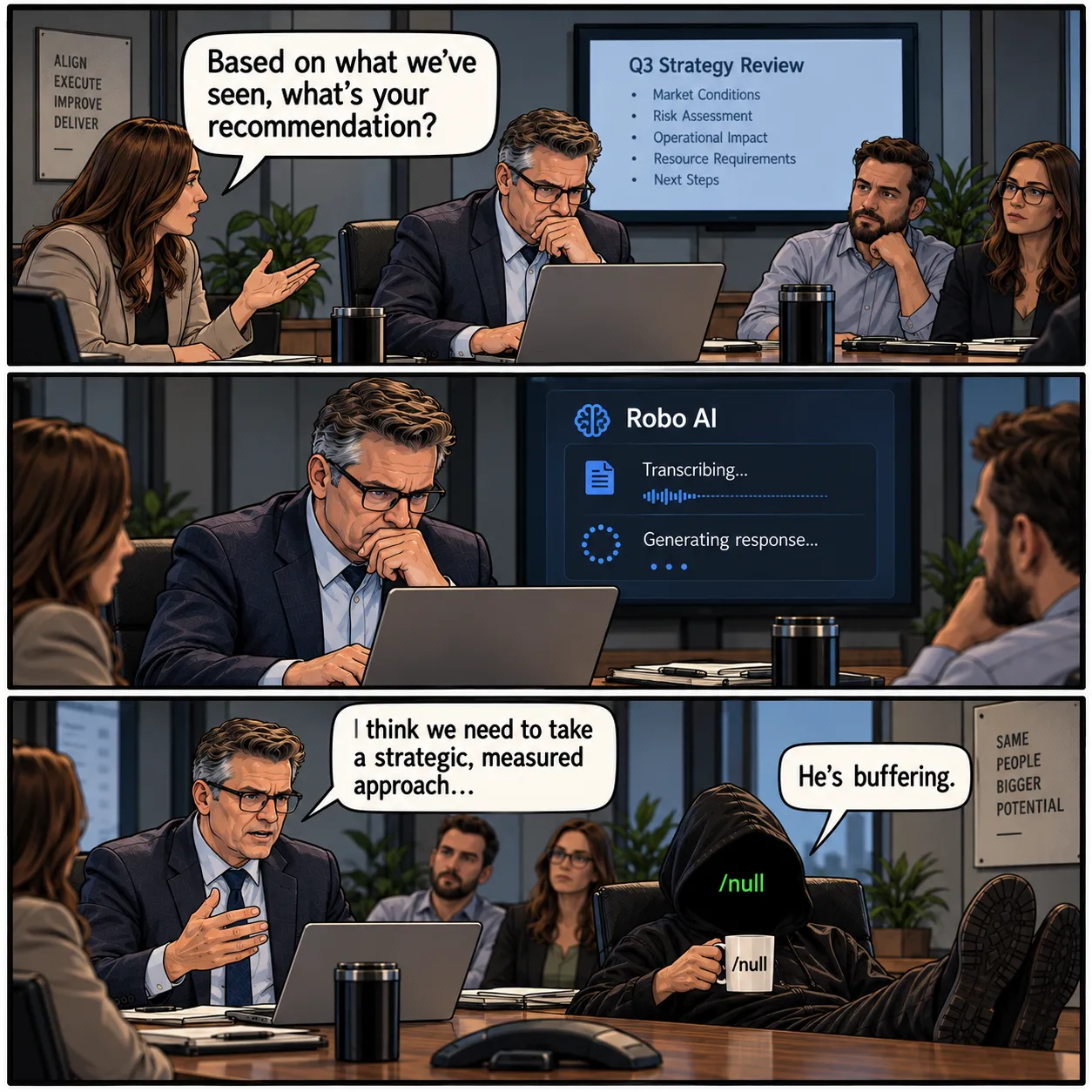
There is a new kind of pause showing up in meetings. Someone asks a question that requires a recommendation, an opinion, or maybe just a little judgment, and instead of getting an answer, everyone waits. It is not necessarily the normal pause of someone considering the problem. The person who was asked the question may be looking at a screen while a meeting transcript catches up, an AI tool processes what was said, and a response begins taking shape. Eventually, the person speaks. The whole process may only take a few seconds, but once you recognize what is happening, the pause becomes difficult not to notice. He’s buffering.

In the last article, I came back to one of the oldest principles in computing: garbage in, garbage out. AI may be far more sophisticated than the systems that gave us GIGO, but the basic problem never disappeared. What we put into a system still influences what comes out of it. The quality of the information, the assumptions behind the question, the context we provide, and even the way we frame the problem can influence the answer we receive. We used to worry primarily about what bad input would do to the computer. With AI, I think we also need to pay attention to what repeated dependence on the output may be doing to us.
I use AI extensively, so this is not an argument for retreating from the technology. I use it for research, analysis, testing assumptions, finding gaps, organizing information, experimenting with ideas, and automating work that does not deserve the amount of human time traditionally spent on it. Some of the systems I am building now would have required considerably more time, people, or money only a few years ago. I have no interest in giving that capability back simply because humanity immediately discovered that AI can also generate terrible emails at industrial scale. What interests me is where we draw the line between using AI to extend our ability to think and using AI so that we do not have to.
When the Tool Moves Upstream

Most AI dependence probably does not begin with someone deciding to outsource their judgment. It begins with reasonable uses of a useful tool. You ask AI to summarize a long document, organize notes from a meeting, clean up something you wrote, compare information, or help research a subject. These are exactly the kinds of tasks technology should make easier, and there is nothing inherently valuable about spending two hours doing something a tool can accomplish in ten minutes. If technology can remove mechanical work while leaving more time for analysis, experimentation, and decision-making, that seems like a pretty good trade.
The relationship changes when the tool begins moving upstream in the decision process. Instead of asking AI to organize the information, we ask it what the information means. Instead of using it to challenge a recommendation, we ask it to create the recommendation. Instead of bringing our judgment to the tool and asking it to test our thinking, we bring the problem to the tool and wait to see what we think. Each step can be perfectly reasonable on its own, which is part of what makes the transition difficult to notice. There is no warning asking whether we would like to outsource a portion of our judgment. The workflow simply becomes a little easier each time until the AI is no longer supporting the thinking. It has become part of the path the thinking must travel through.
Meetings make this particularly visible because conversation normally exposes at least part of how people think. Someone asks a question, another person considers what they know, and they respond. They may ask for clarification, offer an initial opinion, explain their reasoning, or admit that they do not have enough information to make a recommendation yet. None of those responses represents a failure. In fact, knowing when the evidence is insufficient can tell you considerably more about someone’s judgment than hearing a confident answer to every question.
Insert AI between those two people and the interaction changes. The question can be captured, interpreted, combined with other information, and turned into a polished response before the person answers. That response may be better than whatever would have come out spontaneously, and sometimes taking a moment to consult the available tools is exactly the right thing to do. The concern is not the pause itself. The concern is whether the person is consulting the tool as part of their thinking or waiting for the tool to provide the thinking. We have spent decades trying to remove latency from computers. It would be an impressive bit of human engineering if we finally got the machines fast enough only to introduce latency into ourselves.
Competence Debt
Technology has always changed which skills we exercise. Calculators reduced the amount of arithmetic we perform manually. GPS reduced the need to memorize routes. Search engines changed how we retain information because knowing where to find something became almost as valuable as remembering it. Those technologies did not eliminate the need for human knowledge, but they changed what we practiced regularly. AI extends that relationship into more interesting territory because the work being handed over can now include analysis, interpretation, and judgment.
Judgment develops through repetition. We encounter a problem, gather information, determine what matters, make assumptions, choose a course of action, observe what happens, and adjust what we know. Sometimes the decision works. Sometimes reality provides a fairly direct performance review. Both outcomes become part of the experience we bring to the next problem. Over enough repetitions, we begin recognizing patterns, asking better questions, noticing missing information, and understanding which details matter before we commit to a decision.
If AI performs more of that process for us, we should pay attention to what happens to the capability we are no longer exercising. I think of this as competence debt, and it behaves a lot like the technical debt familiar to anyone who has spent enough time around technology. Technical debt is not automatically bad. Sometimes accepting it is a rational choice because solving today’s problem matters more than building the perfect solution. The trouble comes when years of individually reasonable shortcuts accumulate into something expensive, fragile, poorly understood, and somehow critical to the operation of the business.
Competence debt can accumulate the same way. Every time we hand part of a task to a tool, we gain efficiency, but we may also stop practicing some portion of the skill required to perform that task ourselves. That trade is easy to justify when we are automating mechanical work. I have no desire to calculate a thousand-row spreadsheet by hand just to prove civilization still remembers arithmetic. The calculation changes when what we are handing over is the part that requires understanding why the numbers matter, deciding whether they can be trusted, and determining what should happen because of them.
That distinction is important because AI can increase human capability just as easily as it can replace pieces of it. If AI removes repetitive work and gives someone more time to investigate, analyze, compare alternatives, and make decisions, the technology has increased the amount of human judgment available to the organization. If AI gathers the information, performs the analysis, recommends the decision, writes the explanation, and produces the talking points used to defend it, we have created a very different workflow. The human may still be sitting in the chair, but it becomes reasonable to ask what part of the process is actually making that person better at the job.
A Better Answer Still Needs Someone Who Can Recognize It
One of the things that makes generative AI useful is also what makes dependence on it difficult to recognize. It is remarkably good at producing plausible answers. The response can be organized, articulate, appropriately formatted, and confident enough to survive several layers of an organization before anyone asks whether the underlying reasoning is sound. People have always been capable of producing bad recommendations with impressive confidence, so AI deserves no credit for inventing that particular feature. What it changes is the speed and scale at which polished reasoning can be produced.
That makes expertise more valuable, not less. When I use AI in an area I understand well, I have something against which to compare what comes back. I can recognize when the model misunderstood the problem, ignored an important constraint, relied on a questionable assumption, or produced an answer that sounds much better than it would work. I can challenge the response, add context, ask for evidence, change direction, or throw the result away. The AI is useful because it can help me cover more ground, but I do not have to trust the output simply because it arrived with bullet points and a reassuringly professional tone.
The relationship becomes more dangerous when someone does not understand the subject well enough to evaluate the answer. A polished response can be difficult to distinguish from a correct one when there is nothing in the person’s own knowledge pushing back against it. The reasoning appears coherent, the terminology sounds appropriate, and the recommendation may contain enough detail to create the impression that something substantial happened. The less judgment someone brings to that interaction, the more judgment they may unintentionally assign to the machine, and the machine has no awareness that this transfer of responsibility has occurred.
This is why I think some of the discussion about prompt engineering misses part of the problem. Better questions, better context, and better instructions can absolutely produce better results, and learning how to interact effectively with AI is becoming a useful skill. But prompting is only one side of the interaction. The harder skill is deciding whether the answer deserves to survive. That requires understanding the environment in which the recommendation will be used, recognizing assumptions, identifying missing information, considering consequences, and knowing what evidence would cause the conclusion to change. A beautifully constructed prompt cannot replace the ability to evaluate what comes back.
Using AI to Exercise Judgment
The most useful interactions I have with AI are often not the ones where I ask it what I should think. I get more value when I already have an idea, a hypothesis, or a direction and use the technology to make that thinking survive contact with something other than my own assumptions. I can ask it to identify weaknesses in an argument, find evidence I may have overlooked, make the strongest case against my position, compare alternative approaches, or identify what would have to be true for my conclusion to be wrong. That gives me more opportunities to exercise judgment rather than fewer.
There is real value in being able to challenge an idea quickly. Humans are remarkably talented at finding evidence that supports something we already believe, particularly after we have invested enough time, money, or reputation in believing it. Organizations add another layer because titles, politics, deadlines, and ownership can all influence how aggressively an idea gets challenged. AI does not eliminate those problems, but it can provide a relatively cheap way to attack an assumption before reality gets the opportunity to do it at considerably greater expense.
That only works if we are willing to use the tool that way. Asking AI to manufacture support for a decision we have already made is not analysis. It is confirmation bias with better formatting. The goal should be to come out of the interaction understanding the problem better than when we entered it, even if that means discovering that the idea we were trying to defend was wrong.
A simple test is to close the AI window and explain the recommendation to another person. You should be able to explain why you think it is the right decision, what evidence supports it, which assumptions you made, what alternatives you considered, what risks remain, and what information would cause you to change your mind. You do not need to reproduce the AI-generated response from memory because memorizing generated text proves very little. You need to understand the decision well enough that the generated response is no longer required to explain why you made it. If reopening the AI conversation is necessary to discover why you supposedly believe what you just recommended, something more fundamental than drafting assistance has been outsourced.
The Human Still Has a Job
As AI gets better, this distinction will probably become harder to see rather than easier. Models will have more context, better access to organizational information, stronger analytical capabilities, and deeper integration into the tools we already use. Their recommendations will become more useful, which means relying on them will become easier to justify. A mediocre tool constantly reminds us that it is a tool. A very good one can make us forget where its capabilities end and ours begin.
I do not think the answer is to use AI less. Avoiding a powerful technology because dependence is possible makes about as much sense as throwing away a calculator because someone might forget long division. The better approach is to become deliberate about what we are asking the technology to do and which responsibilities we are unwilling to surrender to it. AI should remove work that does not deserve human attention, help us explore more information than we could reasonably process alone, expose blind spots, challenge assumptions, accelerate research, and automate repetition. Those capabilities can make experienced people substantially more effective.
What AI should not become is the place where our judgment lives. That matters for anyone making decisions, but it matters particularly when those decisions affect other people, systems, customers, or organizations. Experience is valuable because when information is incomplete, priorities conflict, and there is no obvious correct answer, someone can still understand the situation well enough to make a decision and accept responsibility for what happens next. AI can contribute to that process, and in many cases it probably should, but responsibility does not transfer to the model simply because part of the reasoning came from it. When the recommendation fails, nobody is putting the chatbot on a performance improvement plan.
That brings me back to the pause in the meeting. Someone asks a question, the transcript catches up, the AI processes the conversation, and a few seconds later the person begins explaining a recommendation. Maybe the recommendation is excellent. Maybe the AI surfaced something nobody else considered, challenged an assumption, or provided information that produced a better decision. If the person can explain that recommendation, challenge its assumptions, adapt it when new information arrives, and make the decision when the AI has nothing useful to offer, then the technology is doing exactly what I want it to do. It is extending human judgment rather than replacing it.
The part worth watching is what happens when that is no longer true. We built AI to reduce the distance between a problem and useful information, and I think it can do that extraordinarily well. The risk is not simply that AI becomes capable of producing better answers. The more immediate risk is that we become comfortable exercising less judgment because something else can produce an answer faster. AI should make capable people more capable, expose weak assumptions, and give us more information with which to make better decisions. It should not become the place where the decision actually lives. If someone asks what you think and the answer cannot begin until the model finishes generating, the technology may no longer be assisting your judgment.
You may just be buffering.