
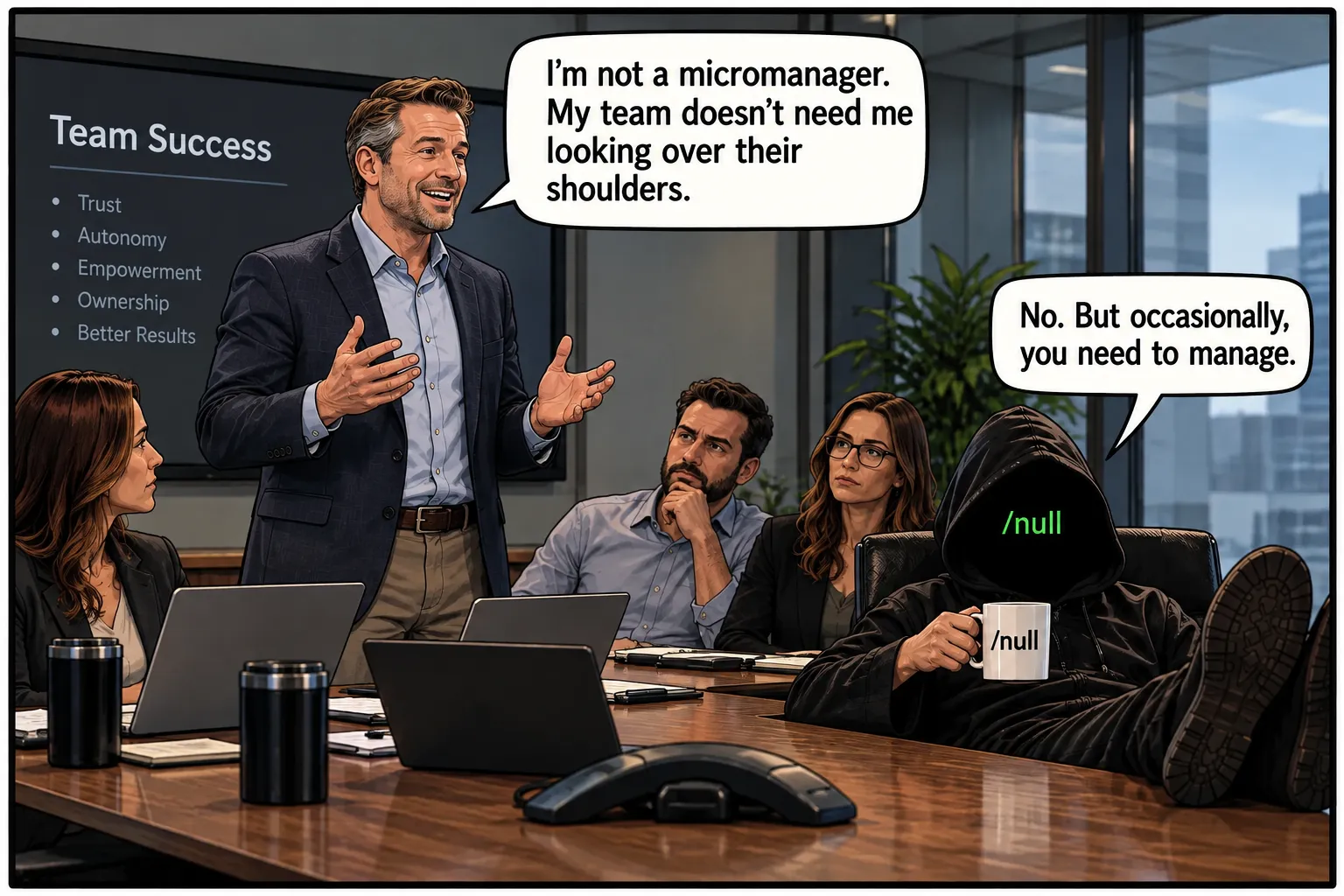
I have heard a lot of managers describe themselves as not being micromanagers. Usually they mean it as a good thing, and most of the time I agree with what they are trying to say. I do not want someone looking over my shoulder, checking every decision, or asking for updates just so they can feel involved. I do not manage people that way either. If I trust someone to do a job, I want them to have enough room to actually do it.
What bothers me is when “I’m not a micromanager” becomes an explanation for why the manager is barely involved at all. There is a pretty wide gap between controlling everything someone does and having no idea what is happening around them. Not living in somebody’s inbox, calendar, ticket queue, or project plan does not automatically mean you have mastered the art of empowerment. Sometimes it just means you are not paying attention.
I tend to give people a lot of room, but I can only do that effectively if I know who I am giving that room to. I need to understand what someone knows, where they are strong, where they need development, and how they approach problems. I also need to know what happens when things go wrong. Someone who consistently demonstrates good judgment should not have to keep proving they can make routine decisions. At some point, continuing to hover over them stops being management and starts becoming interference.
You Have to Know When to Get Out of the Way
I have spent a lot of my career around technical people, and one of the fastest ways to frustrate a good technical person is to hire them for their expertise and then insist they do everything the way you would have done it. At that point, I am not sure why you hired them. You could have saved everyone some time and just given yourself another job.

When I work with someone, I want to understand how they think and how they approach their work. That takes time. You learn it by working through real problems together, seeing what they do when the obvious answer does not work, and finding out whether they know when they have reached the edge of what they know. They are learning the same things about me. Eventually, we have enough history that neither of us has to guess how the other person will respond every time something changes.
As that relationship develops, I should need to be involved less. If someone demonstrates that they can make sound decisions, I do not need them coming back to me every time another decision appears. If they become better than I am at something, even better. I have never understood managers who seem threatened when somebody working for them becomes the expert. Developing people who can operate without you constantly touching their work is not losing control. It is one of the things you are supposed to be doing.
I still manage this way today, although it does not always happen through a traditional reporting relationship. I work across teams where I may not be the person who signs someone’s performance review, but we still have to solve problems, make decisions, challenge each other, and figure out who needs to own what. You cannot fall back on the org chart every time you need something done in those relationships. People have to know how you operate, and you have to give them a reason to trust your judgment.
For me, being hands-off is not really a management style. It is what becomes possible once I understand the people around me and trust them to handle what they own.
Sometimes the Problem Changes
Years ago, I had an engineer who took over responsibility for our firewalls. I had originally managed that environment myself, but as my role changed, I needed to stop being the firewall guy and let her become the firewall engineer. Over time, that is exactly what happened. They became her firewalls. She knew the environment, she made the technical decisions, and I had no interest in standing over her telling her how I would write a rule.
Eventually, those firewalls reached the end of their support lifecycle and we had to replace them. She engineered the replacement. When the new equipment arrived, I handled some of the work at the data center. I traced and labeled cables, racked equipment, and got things ready so she and one of our analysts could handle the actual cutover. I was perfectly happy doing the grunt work because she owned the technical implementation. My title did not suddenly make me the best person to configure the new firewalls.
The cutover date moved a couple of times. Initially, I let it move because there was room to move it. Then we reached the actual deadline. The existing equipment was about to lose vendor support, so delaying again was no longer just a scheduling decision. The risk had changed.
The weather was not particularly good, and she was about two and a half hours from the data center on a good day. She wanted to move the cutover again. I told her no. We had an outage scheduled in twelve hours, she had twelve hours to get there, and she should drive slowly.
I did not suddenly start telling her how to replace the firewalls. That was still her job, and by then she knew that environment better than I did. We were no longer deciding how to perform a technical migration. We were deciding whether the organization was going to knowingly run unsupported security infrastructure because we moved the deadline again.
That decision was mine.
After that, I did not take the technical work back from her. There was no reason to. She still owned the firewalls. I had stepped in because the decision had moved into my part of the job, not because I suddenly needed to become involved in hers. That distinction is a big part of how I think about management.
What Do You Owe People?
Over the years, I have worked with people who needed almost no involvement from me once we established what they owned. Others needed more coaching or clearer expectations before I could give them that much room. People also change. Someone who needed a lot of help a year ago may not need much today, while someone who normally operates independently can run into a problem where having me involved actually helps.
If I manage all of those people exactly the same way because I have decided that I am a “hands-off manager,” then I am making them adapt to me instead of managing the people actually in front of me.
What I owe them equally is respect, although respect does not look the same in every situation. I can respect someone’s experience by staying out of work they clearly know how to handle. With someone who is still learning, respect may require more of my time. There are also times when someone recommends an approach I would not have chosen myself, and unless I have a good reason to override it, they need room to make that decision. Giving people ownership while quietly requiring them to make every decision exactly as I would have made it is not much of an improvement over doing the work myself.
I expect people to own their mistakes, and I would much rather have someone come to me and tell me they screwed something up than discover it from somebody else after the problem has had a few days to mature. For that to work, they need to know that bringing me a problem starts a conversation about what we do next. I still expect them to own what happened, but I am much more interested in dealing with the problem than staging a corporate production about blame.
People are going to make bad calls occasionally. So am I. Trusting someone enough to give them authority does not require pretending otherwise. Humans have been testing that particular feature for thousands of years, and the results remain mixed.
None of this gives me a formula for exactly how involved I should be. I don’t think one exists. There are days when adding myself to a problem would accomplish little beyond increasing the number of people discussing it. Other problems land squarely in my lap, whether I particularly wanted them there or not. Knowing the people and staying connected to the work gives me a decent chance of recognizing which one I am dealing with.
Occasionally, You Need to Manage
I want capable people around me, and I want them to have enough room to become more capable. If somebody becomes better than I am at part of the job, that is not a problem I need to solve. If every meaningful decision still has to come through me, however, I have not built much of a team. I have built a queue with my name on it.
Getting out of that queue does not mean disappearing. Eventually, even people who normally need very little from me are going to run into something that lands on my side of the line. When that happens, my job is not to take their work away from them. My job is to handle my part of it.
That is what gets lost when “I’m not a micromanager” becomes an entire management philosophy. I agree that your team probably does not need you looking over their shoulders.
But occasionally, you need to manage.