
There is a particular kind of improvement that shows up everywhere now.
“We’ve updated the process.”
Usually there is an app involved.

Or a QR code.
Or an account you need to create.

Or a phone that now needs to be charged, connected, updated, authenticated, and available to accomplish something that previously required handing another human a piece of paper.
The new process may genuinely be better.
But there is another question worth asking.
Better for whom?
Moving Work Around
Systems do not always eliminate work when they become more efficient.
Sometimes they move it.
A task that used to be performed by an employee becomes something the customer performs.
You enter the information.
You scan the item.
You print the label.
You download the app.
You troubleshoot the account.
You navigate the menu.
You provide the device, connectivity, battery, and increasingly the technical support required to complete the transaction.
From the organization’s perspective, that can be an enormous improvement.
Less labor. Faster transactions. Better data. More automation. Lower operating costs.
Those are real benefits.
They just do not automatically mean the experience improved for everyone using the system.
Convenience Has Dependencies
A paper ticket is primitive.
It also has an interesting feature.
Once you have it, it does not need a battery.
A digital ticket can be far more convenient. It can update automatically, live inside something you already carry, and eliminate another object from your pocket.
But it also introduces dependencies.
- The phone has to work.
- The battery has to last.
- The application has to function.
- The account has to be accessible.
- The screen has to be readable.
- The system on the other end has to recognize it.
That does not make the digital system bad.
It makes the digital system a system.
And systems should be evaluated by their dependencies as well as their features.
Optimization Depends on Where You Stand
This is where words like better, easier, and more convenient become interesting.
They sound like descriptions.
Often they are conclusions drawn from a particular point of view.
A process can reduce staffing requirements while increasing the amount of work performed by customers.
It can reduce transaction time on average while making exceptions considerably harder to resolve.
It can make the experience easier for most users while creating a significant barrier for someone without the expected technology.
All of those things can be true at the same time.
Which is why “the new process is better” tells us surprisingly little.
Better is not a measurement until we know what was measured.
Follow the Work
Whenever a process is redesigned, I like a simpler question.
Where did the work go?
If automation actually eliminated unnecessary work, good.
If technology made something faster and easier for everyone involved, even better.
But if the work merely moved from one side of the transaction to the other, that should be part of how we describe the change.
The same applies to risk.
And cost.
And complexity.
Moving something does not make it disappear.
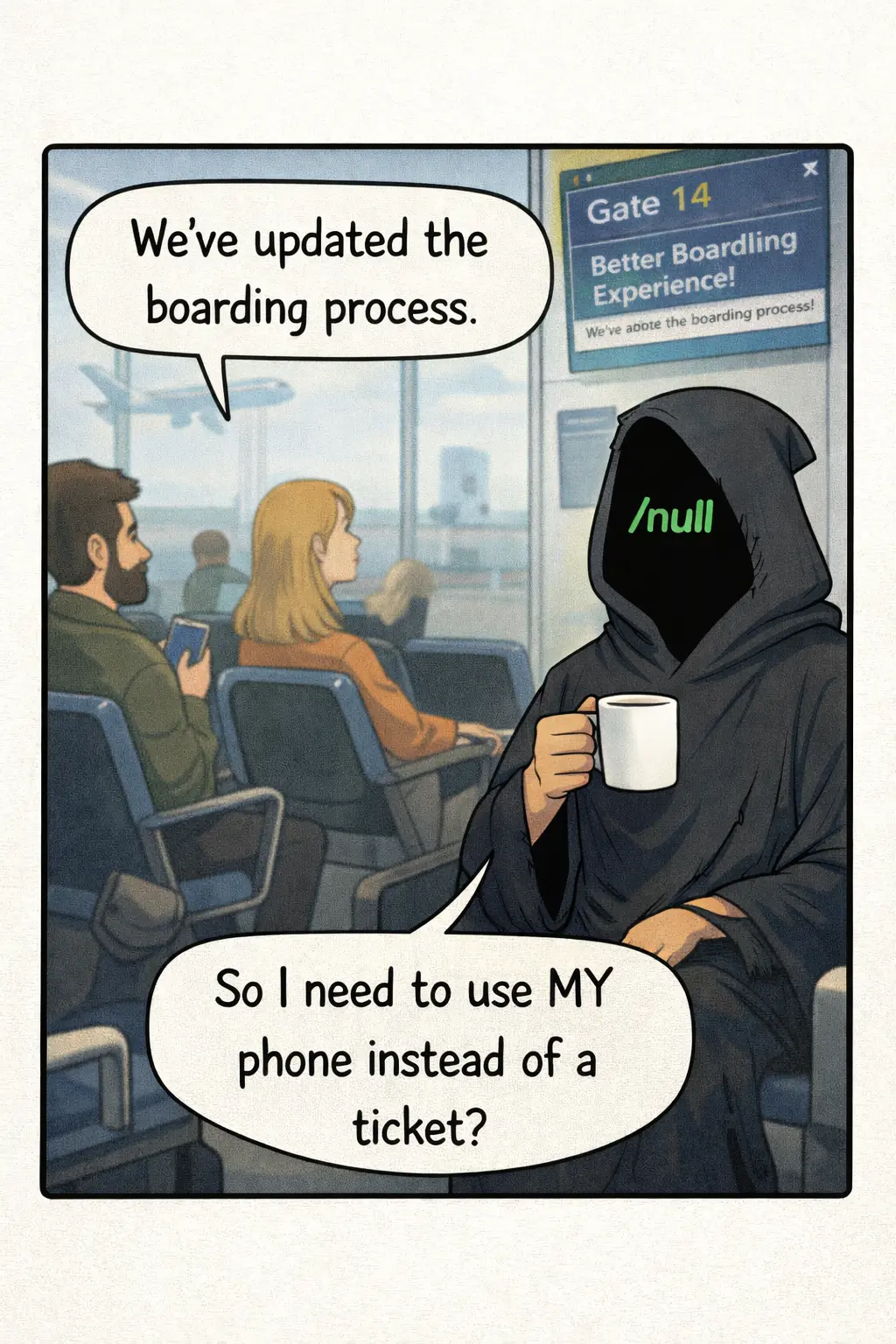
Someone announces:
“We’ve updated the boarding process.”
/null looks at the ticket on his phone.
“So I need to use MY phone instead of a ticket?”
Maybe the new process really is better.
Just remember to ask who got the improvement.