Organizations love a fresh start.
“We have a bold new direction.”
Maybe.
New leaders arrive. Priorities shift. Departments merge. Reporting lines move. Someone inevitably creates a slide containing arrows pointing toward something called the future state.
Sometimes those changes are necessary.
Organizations have to adapt. Markets change. Technology changes. Strategies that once worked stop working.
But changing the organization and changing the system are not necessarily the same thing.
Move enough boxes around an organizational chart and everything looks different.
The more useful question is whether anything underneath it actually changed.
Follow What Actually Changed
Structure matters.
Reporting relationships, responsibilities, authority, staffing, and resources can all affect how an organization performs.
A poorly designed structure can create duplication, slow decisions, hide accountability, and give people responsibility without the authority to act.
Changing that structure can solve real problems.
But structure is only one part of the system.
The incentives may still be the same.
The information may still flow through the same bottlenecks.
The same decisions may still require the same approvals.
The same behaviors may still be rewarded.
The same assumptions may still drive the same decisions.
And the problem that justified the restructure may still be sitting underneath all of it.
So before being impressed by how much changed, I want to know what changed in the system.
Change Can Become a Loop
Jim Collins described two useful ideas in Good to Great: the Flywheel and the Doom Loop.
The flywheel is the one I believe in and try to build on, both at work and in my own life.
The basic idea is simple.
Progress does not have to come from one enormous breakthrough.
You make a good decision. You learn from the result. You make the next decision a little better. You keep what works. You correct what does not. Then you push again.
Each turn builds on the last.
Eventually those individual improvements begin reinforcing one another.
That applies to organizations, technology, careers, skills, finances, relationships, and just about anything else worth improving.
It is not particularly dramatic.
That is part of why I like it.
Activity creates motion. Learning creates momentum.
The Doom Loop works differently.
A problem appears.
A new direction is announced.
The organization restructures.
The restructure creates disruption of its own.
Results take longer than expected.
Confidence fades.
Another new direction arrives.
And everyone pushes a different flywheel.
The organization can be incredibly busy while accumulating very little.
Did It Work?
This is the part of organizational change that interests me most.
What happens after the announcement?
If we knew what problem justified the change, we should eventually be able to determine whether the change affected it.
- What outcome were we trying to change?
- What changed in the system?
- What happened afterward?
- What did we learn?
- What are we keeping?
Those questions create a feedback loop.
They allow the next decision to start with what the organization learned from the previous one.
That is how the flywheel keeps turning.
Without that feedback, change can become its own justification.
The restructure proves something needed to change.
The disappointing result proves something still needs to change.
And another restructure becomes evidence that the organization is responding.
There is plenty of motion.
Whether there is momentum is another question.
Build on What You Learn
This is why the flywheel has stuck with me beyond organizational strategy.
It is how I prefer to approach work and life.
Understand where you are.
Make the best decision you can with the evidence you have.
Pay attention to what happens.
Keep what worked.
Change what did not.
Then start the next turn with more knowledge than you had before.
That does not mean never making a major change. Sometimes the evidence tells you that a major change is exactly what the system needs.
But even a major change should become part of the next turn, not erase everything that came before it.
The goal is not constant change.
The goal is accumulated progress.
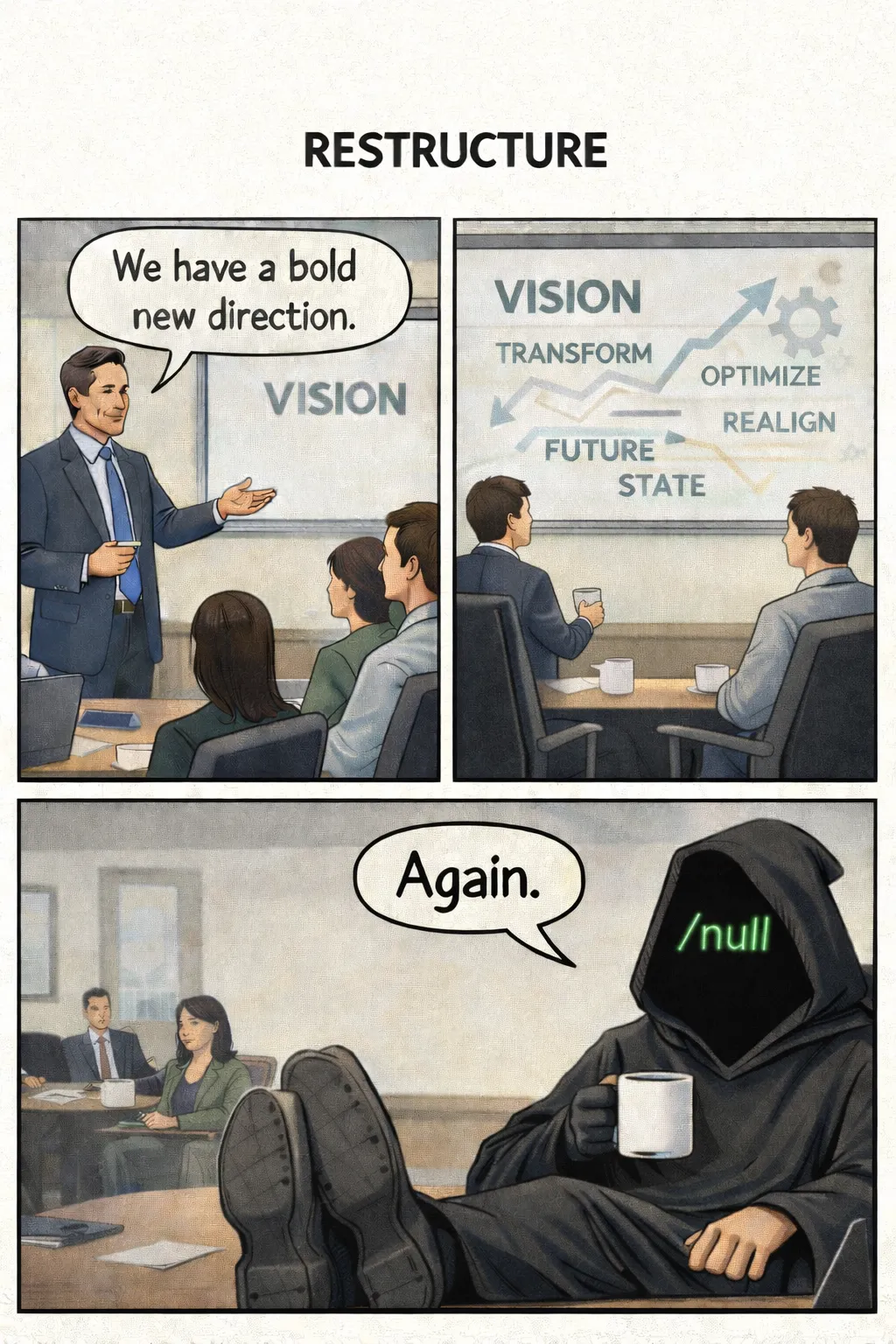
Leadership announces:
“We have a bold new direction.”
The presentation explains the vision.
Transform.
Optimize.
Realign.
Future state.
Then /null finally enters the room.
“Again.”
Sometimes one word is enough to identify the pattern.
The question is not whether the organization is changing.
It is whether this turn builds on the last one, or starts the same loop all over again.