
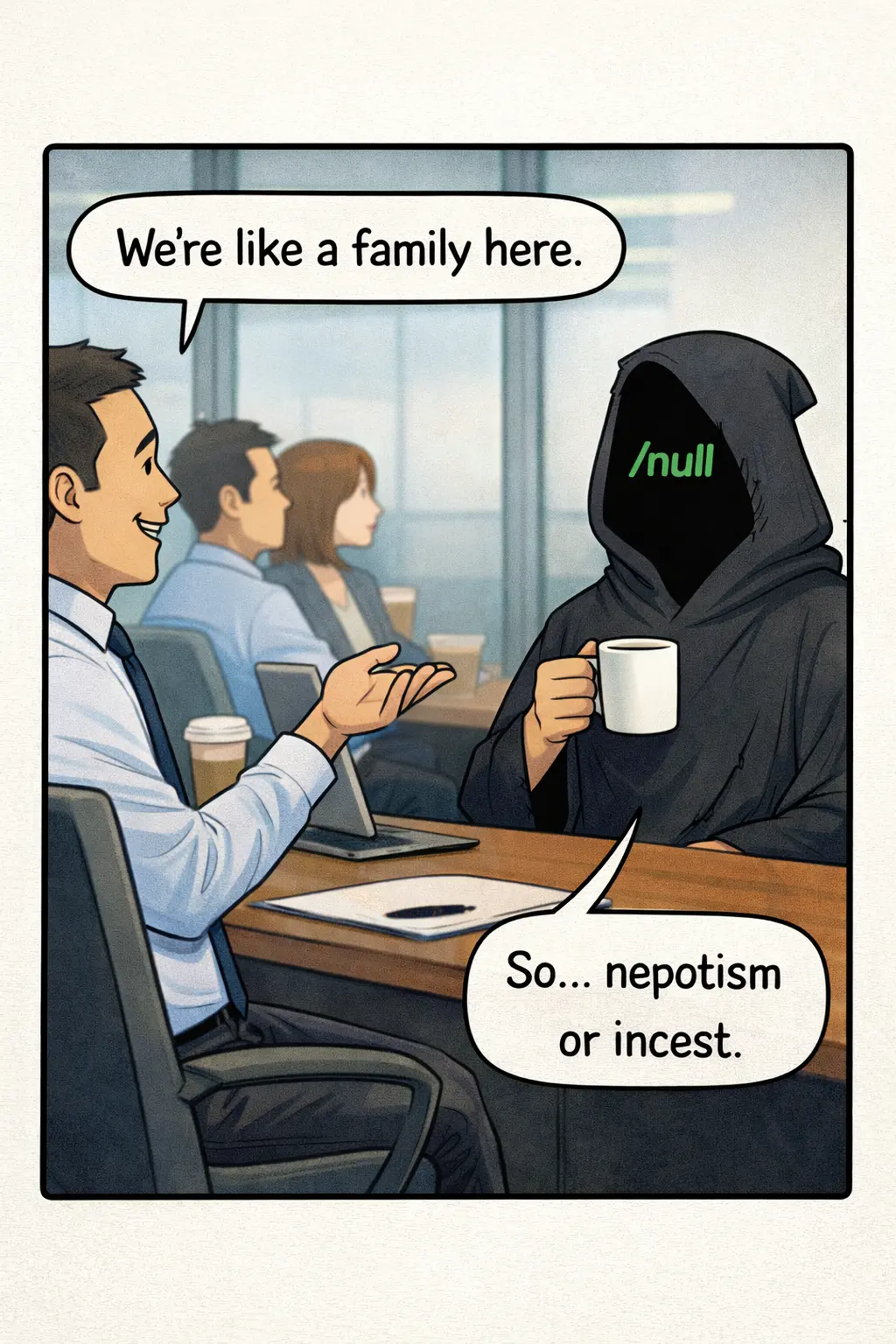
There are phrases we hear so often that eventually we stop asking what they mean.
“We’re like a family here.”
It sounds good.
Trust. Loyalty. People looking out for one another.
Then /null takes it literally.
“So… nepotism or incest.”
And suddenly the metaphor has a problem.
What Does “Family” Actually Mean?
The interesting part isn’t whether the phrase is stupid.
The interesting part is why organizations use it.
Usually they’re trying to describe something positive. Trust. Commitment. Loyalty. Shared responsibility. People willing to help each other when things go sideways.
Those are good things.
But a workplace isn’t a family.
A family relationship exists whether it is productive or not. A working relationship exists because two sides are exchanging value.
You provide time, judgment, knowledge, and effort.
The organization provides compensation, opportunity, resources, and an environment where you can hopefully do useful work.
That doesn’t make the relationship cold.
It makes it honest.
Watch What the System Does
I’ve spent most of my career working with systems.
Technology. Security. Organizations. Processes. Teams.
One lesson transfers remarkably well between them: don’t judge a system only by what it says it does.
Watch what it actually does.
A company can call itself a family.
Then the company has a bad quarter.
Budgets get cut.
Projects disappear.
Departments get reorganized.
People get laid off.
That doesn’t automatically make the organization bad. Sometimes those decisions are necessary for the organization to survive.
But nobody announces at Thanksgiving that Grandma has been eliminated because her position no longer aligns with the family’s strategic priorities.
At least not at the better Thanksgivings.
So maybe “family” isn’t describing the system very well.
Ignore the Poster on the Wall
If you want to understand an organization, look at its incentives and behavior.
- What behavior gets rewarded?
- What behavior gets punished?
- What happens when resources become scarce?
- Who absorbs the cost when something fails?
- What happens when someone delivers bad news?
- Do the actions match the stated values?
A poster on the wall can say PEOPLE FIRST.
The operating system underneath it might say something completely different.
The operating system wins.
Every time.
Build the Relationship You Actually Want
None of this means people shouldn’t care about the people they work with.
They should.
Some of the strongest relationships I’ve built came from working beside people through difficult problems.
Trust gets built when someone does what they said they would do. When they tell you they screwed up before you discover it yourself. When they share what they know. When they challenge you when you’re wrong. When they show up when things go sideways.
None of that requires pretending we’re related.
Maybe the better model is simpler.
We have a job to do.
We depend on one another.
We treat people fairly.
We disagree without destroying each other.
We share credit.
We take responsibility.
And when circumstances change, we tell people the truth.
That doesn’t sound as warm as “we’re a family.”
But it describes something worth building.
Question the Abstraction
Language matters because language creates assumptions.
Once an assumption becomes familiar enough, we stop examining it.
That’s where bad abstractions survive.
Sometimes the easiest way to test one is to strip away the comfortable meaning and ask what the words actually describe.
Organizations don’t need to pretend employment is something it isn’t.
They need to build relationships people don’t have to pretend to believe in.
“We’re like a family here.”
/null: “So… nepotism or incest.”